Workload is the strongest driver of poor police wellbeing, national report finds
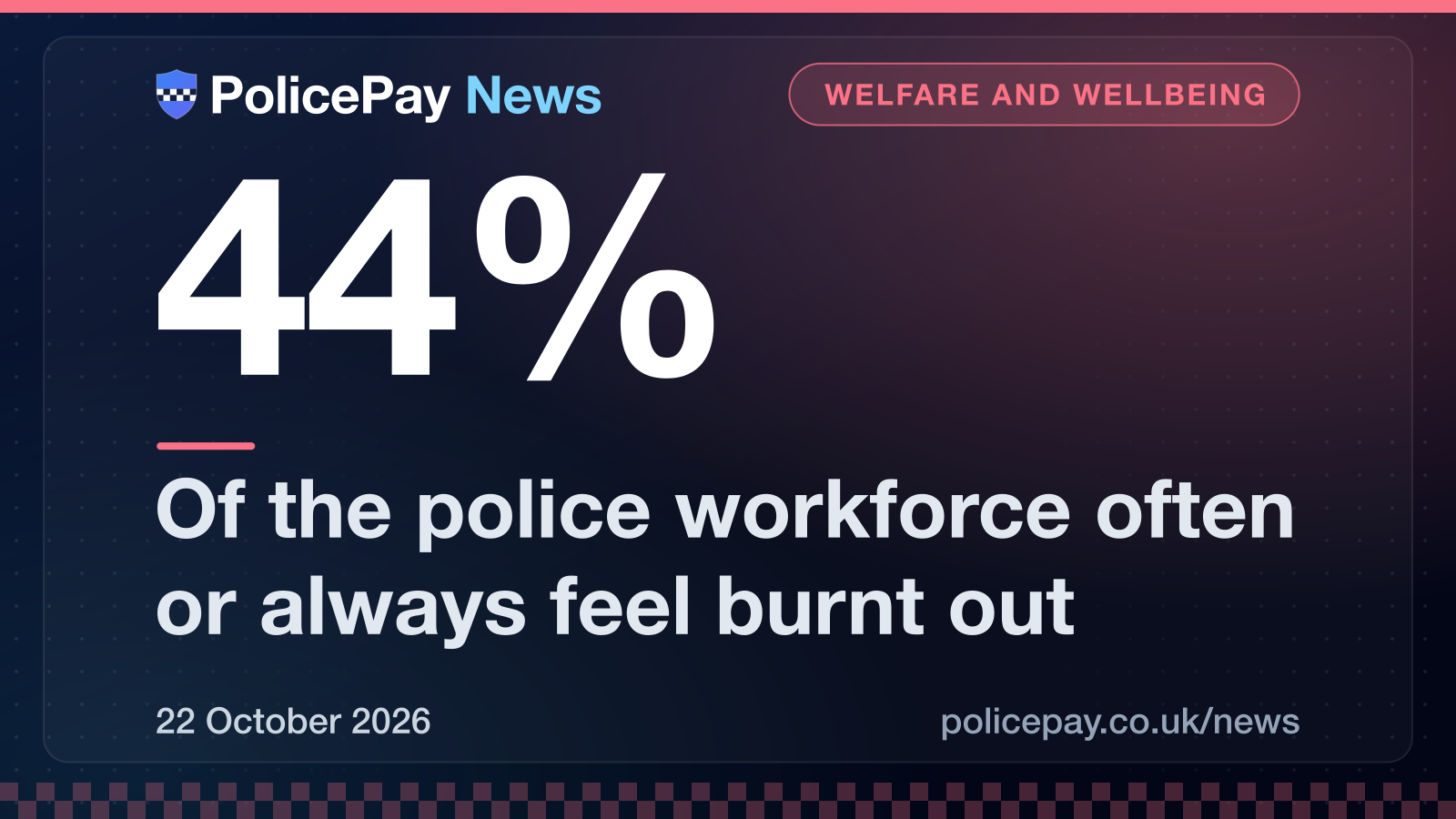
44% of the police workforce often or always feel burnt out because of their job, against 32% in the NHS. A new national report finds heavy workload is the strongest driver of poor wellbeing and says this is "not purely a resilience issue". Here is what it found and what it means for you.
What it means for you
- Burnout is widespread: 44% of the police workforce often or always feel burnt out because of their job, against 32% in the NHS.
- The report finds workload pressure is the strongest driver of poor wellbeing, even for highly engaged people or those with supportive line managers.
- Constables, sergeants and incident response teams are hardest hit: 55% of constables report burnout.
- Nothing changes automatically. These are findings and recommendations for forces, not new rules. Talk to your line manager about workload and check you claim any overtime you are owed.
- Support is there now, day or night: the Oscar Kilo Mental Health Crisis Line on 0300 131 2789 or Samaritans on 116 123.
Work it out, free
Police overtime calculator
Working past the end of your shift? See what those hours are worth at the correct overtime rate.
Open the police overtime calculatorThe National Police Wellbeing Service, known as Oscar Kilo, published the first of three "deep dive" reports from its 2026 National Police Workforce and Wellbeing Survey on 19 October 2026. The report, How can we improve the wellbeing of our workforce?, was produced by the research firm Leapwise for Oscar Kilo. It looks behind the headline results published in August at what drives poor wellbeing. Its answer: workload pressure.
The survey ran from 1 June to 29 June 2026 in 33 forces and received 56,677 valid responses (the figures below cover the territorial forces in England and Wales) from officers, staff, specials and volunteers. Across the workforce, 56% said they are often or always fatigued or physically exhausted by work. 45% often or always find their work emotionally exhausting and 44% often or always feel burnt out because of their job. 53% agreed they face unrealistic time pressures and 55% find it difficult to take enough breaks.
Police wellbeing in 2026 at a glance
- 56% Often or always fatigued or physically exhausted by work Oscar Kilo survey 2026
- 45% Often or always find work emotionally exhausting Oscar Kilo survey 2026
- 44% Often or always feel burnt out because of their job Oscar Kilo survey 2026
- 55% Find it difficult to take enough breaks Oscar Kilo survey 2026
Four figures from the 2026 National Police Workforce and Wellbeing Survey. 56% of the police workforce are often or always fatigued or physically exhausted by work. 45% often or always find their work emotionally exhausting. 44% often or always feel burnt out because of their job. 55% find it difficult to take enough breaks.
Workload is the strongest driver
The researchers modelled which survey answers are most closely linked to wellbeing. Facing unrealistic time pressures and finding it hard to take breaks came out on top. Feeling that pay is unfair was the third strongest factor and is linked to stress about finances. The report says the link between workload and wellbeing holds across roles and ranks, even for the most engaged people and those with the most supportive line managers. In its words, this is "not purely a resilience issue".
The report also compares policing with a 2025 NHS benchmark. 44% of the police workforce often or always feel burnt out, against 32% in the NHS. 45% find their work emotionally exhausting, against 35%. 53% face unrealistic time pressures, against 29%.
Policing compared with the NHS
Police workforce
44%
- Feel burnt out
- 45% find work emotionally exhausting
- 53% face unrealistic time pressures
NHS staff
32%
- Feel burnt out
- 35% find work emotionally exhausting
- 29% face unrealistic time pressures
Policing compared with the NHS. 44% of the police workforce feel burnt out, against 32% of NHS staff. 45% of the police workforce find their work emotionally exhausting, against 35% in the NHS. 53% face unrealistic time pressures, against 29% in the NHS.
Worst at the front line
The pressure is heaviest in local incident response, where 73% are fatigued or physically exhausted by work, 63% are burnt out, 82% face unrealistic time pressures and 87% struggle to take enough breaks. Burnout rises with each step down the ranks: 18% for ACC and above, 36% for superintendents, 39% for chief inspectors, 49% for inspectors, 53% for sergeants and 55% for constables.
Burnout by rank, 2026
Bar chart of the share of officers who often or always feel burnt out because of their job, by rank: ACC and above 18%, superintendent 36%, chief inspector 39%, inspector 49%, sergeant 53% and constable 55%.
For response teams, the modelling suggests workload explains almost all of the gap: if their workload pressure were brought up to the workforce average, their wellbeing would be close to average too. Officers on shifts also report much higher workload pressure. Shorter shifts and avoiding night shifts appear to boost wellbeing by around 10%, the report says.
Unpaid hours and the wish to leave
63% of the workforce work unpaid hours and 44% work an hour or more unpaid each week. The most common reason given was that it helped people manage their workload (40%). Only 37% of the police workforce report not working unpaid hours, compared with 51% in the NHS. Among ranks, 69% of constables and 76% of sergeants work unpaid hours. By function it is highest in incident response (81%), roads policing (70%) and neighbourhood policing (68%).
Workload also shows up in retention. Among people in the survey who said they would like to leave their force, the most common reason was better work-life balance (54%). When people were asked what makes it hard to get health and wellbeing support, the most common answer was lack of time or workload pressure (38%).
Get the next welfare and wellbeing news first
National support services, wellbeing findings and changes that affect you.
Occasional emails, no spam, unsubscribe any time. See our privacy policy.
Groups that need more than a lighter workload
For some groups, workload does not explain the whole gap. Colleagues with mental health conditions had the lowest score on the report's wellbeing index (3.4). People on limited duties, younger colleagues aged 25 to 34 and neurodivergent colleagues also scored lower even after workload and other factors were taken into account. The report calls for targeted support for these groups, including follow-up after trauma, illness and periods of restricted duties, flexible working and workplace adjustments.
What happens next
The recommendations are for forces and national bodies: streamline internal processes, manage demand better, train managers to manage pressure rather than pass it down and give targeted support. 43% of respondents picked "leaders managing pressure, instead of passing it down" as one of the two leadership areas most in need of improvement. Oscar Kilo says two more deep dives will follow, on leadership and change and on access to wellbeing support. It is not a new rule, so nothing changes automatically.
If work is wearing you down
You do not have to wait for national change. Our guide to burnout in policing covers the warning signs and practical steps. Our guide to shift work and fatigue explains what helps on nights. If you are a constable or sergeant and regularly work past the end of your shift, check whether that time should be claimed. Under regulation 25 of the Police Regulations 2003 and the Annex G determination, you can be compensated, subject to the Annex G conditions, for time worked after a tour of duty ends, on recall between tours or on an early start without due notice (8 hours) on a day you have already completed your normal daily period of duty. Inspectors and above are not paid overtime. Police staff should check their own terms and conditions. Our police overtime guide explains the rates and which ranks are paid. If you are on adjusted or recuperative duties, see restricted duties explained.
Support is available now. The Oscar Kilo Mental Health Crisis Line is confidential and open 24 hours a day on 0300 131 2789. Since September 2026 it is also open to people who have left policing. Police Care UK gives free, confidential support to serving and former officers, staff, volunteers and their families who have suffered harm as a result of policing. Samaritans answer any time, day or night, on 116 123. Our mental health support directory lists other services.
Go deeper: welfare and wellbeing guides and free tools
Related guides
Sources
- Oscar Kilo, How can we improve the wellbeing of our workforce? National Deep Dive Report: Wellbeing and Workload (Leapwise for Oscar Kilo, dated September 2026, published 19 October 2026), PDF. Survey dates (1 June to 29 June 2026), 33 forces, 56,677 valid responses; workforce figures (56% fatigued or physically exhausted, 45% emotionally exhausting, 44% burnt out, 53% unrealistic time pressures, 55% difficult to take enough breaks); NHS 2025 comparison (32%, 35%, 29%); incident response (73%, 63%, 82%, 87%); burnout by rank (ACC and above 18%, superintendent 36%, chief inspector 39%, inspector 49%, sergeant 53%, constable 55%); unpaid hours (63%, 44%, 40%, 37% against 51% in the NHS, constables 69%, sergeants 76%, incident response 81%, roads policing 70%, neighbourhoods 68%); reasons to leave (better work-life balance 54%) and barrier to support (lack of time or workload pressure 38%); wellbeing index for mental health conditions (3.4); shift effect (around 10%); leadership (43%); recommendations. Accessed 22 October 2026.
- Oscar Kilo, New national deep dive explores what is really affecting wellbeing across policing (19 October 2026). Publication of the first of three deep dives; workload as the strongest driver; groups needing targeted support; the two further deep dives on leadership and change and on access to wellbeing support. Accessed 22 October 2026.
- Oscar Kilo, Confidential Mental Health Crisis Line now extended to those who have left policing (10 September 2026). Crisis line number 0300 131 2789, available 24/7, now open to people who have left policing. Accessed 22 October 2026.
- The Police Regulations 2003, regulation 25 (overtime), legislation.gov.uk. Compensation for time worked after a tour of duty ends, on recall between tours or on an early start without due notice. Accessed 22 October 2026.
- Police Care UK. Free and confidential support for serving and former officers, staff, volunteers and their families. Accessed 22 October 2026.
- Samaritans, Contact a Samaritan. 116 123, any time, day or night. Accessed 22 October 2026.
Corrections: if we get something wrong, we fix it, update the time above and record it in our public corrections log. To report an error, contact us with the figure and your source. This article is general information, not financial or legal advice. Read our news standards.
Get the next welfare and wellbeing news first
National support services, wellbeing findings and changes that affect you.
Occasional emails, no spam, unsubscribe any time. See our privacy policy.
Prefer LinkedIn? Follow PolicePay on LinkedIn for each new item.