Fairfield Review: the Met made good progress on none of the 14 Casey recommendations it graded
Dr Gillian Fairfield's independent review, published on 25 November 2026, finds the Met "is different. It is not yet different enough." Here is what it found on speaking up, morale, vetting and leadership. It matters if you work in the Met or want to join.
What it means for you
- If you work in the Met: only 44% of the review's survey respondents were confident raising a concern about a senior officer. The review says a positive culture needs confidence that speaking up will improve rather than damage a career. Whistleblowing law already protects officers and staff who make a protected disclosure.
- The Met says it accepts all 10 recommendations, including defining the culture it wants with its officers and staff and making wellbeing a core operational priority. A recommendation is not a timetable: the Met's statement gives no dates for delivering them.
- None of the 10 recommendations is about pay. The changes that have already hit day-to-day working life, such as the rotation policy and changes to adjusted duties, are criticised for how they were rolled out, not for their aims.
- If you are applying to join the Met: expect thorough vetting. The review found vetting is stronger but refusal rates differ sharply by ethnicity and the Met has not yet clearly explained why.
The Fairfield Independent Review of the Metropolitan Police Service was published on 25 November 2026. The Met and the Mayor's Office for Policing and Crime (MOPAC) jointly commissioned Dr Gillian Fairfield to assess progress on the recommendations of Baroness Casey's March 2023 review of the Met's standards of behaviour and internal culture. Her 389-page report concludes that the Met "is different. It is not yet different enough."
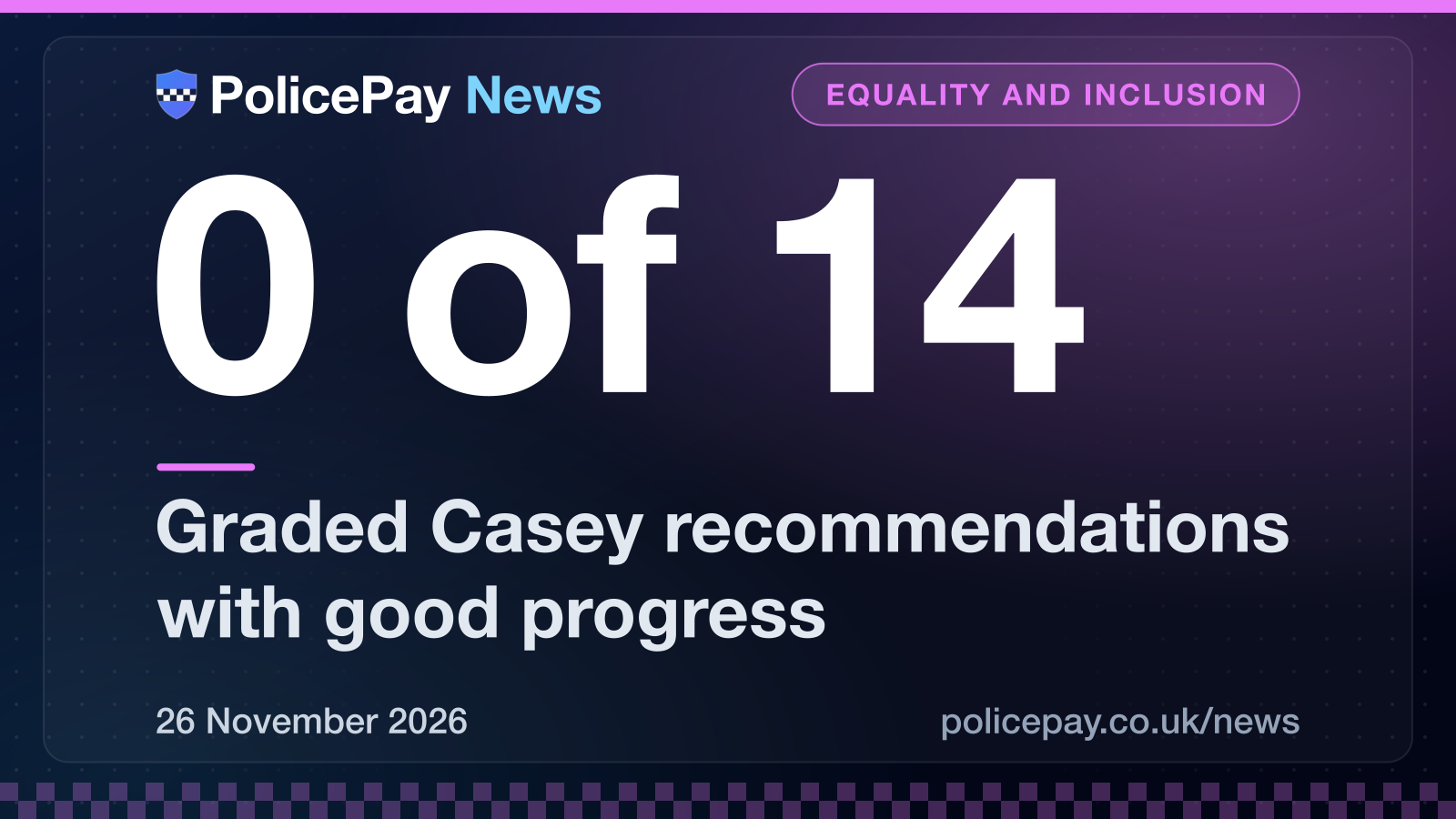
The review graded the Met's progress on 14 of Casey's recommendations. It rated 0 of 14 as good progress, 9 as some progress and 5 as limited progress. The five rated limited are embedding the highest ethical standards; a children's strategy; apologising and rebuilding consent where it is most at risk; rebuilding frontline policing, strengthening borough leadership and providing trauma and counselling support; and reforming governance, scrutiny and accountability. Our full summary of the Fairfield Review lists every grade and every recommendation.
Fairfield's verdict on Casey's recommendations
- 0 of 14 Graded as good progress Fairfield Review
- 9 Graded as some progress Fairfield Review
- 5 Graded as limited progress Fairfield Review
- 10 New strategic recommendations for the Met Fairfield Review
The Fairfield Review graded the Met's progress on 14 of the Casey Review's recommendations: 0 of 14 as good progress, 9 as some progress and 5 as limited progress. It makes 10 new strategic recommendations.
On the headline finding, the review says the "fundamental, systemic issues" of racism, misogyny and homophobia that Casey identified remain. It agrees that the four tests Casey used to reach her conclusion that the Met was institutionally racist, misogynistic and homophobic "still hold".
Speaking up and misconduct
The review's own survey of the Met's workforce received 6,437 responses. 83% of respondents were confident raising concerns about a colleague. That fell to 64% for concerns about a supervisor and 44% for a senior officer. Only around 59% had any confidence that concerns would be acted on appropriately.
Confident raising a concern, by who it is about
In the Fairfield Review survey of 6,437 Met officers and staff, 83% were confident raising concerns about a colleague, 64% about a supervisor and 44% about a senior officer.
Of respondents who said they had felt bullied or harassed at work, 49% had not reported it. Of those who did report it, 67% said no action had been taken. 51% felt leaders were not held to account when they failed to address misconduct. The review heard concern that people who report misconduct, particularly women and ethnic minority members of the workforce, often face counter-allegations.
The review also credits real change. It says vetting and integrity controls are stronger and the Met is taking firmer action against officers and staff who fall below the standards required. The share of conduct cases with a case to answer or substantiated doubled from 23% in 2022/23 to 46% in 2025/26. But cases taking over two years to conclude rose from 7% to 16%. Black and ethnic minority officers were "1.6x more likely" than White officers to be the subject of misconduct allegations in 2025/26, the same as in 2022/23.
If you are thinking about raising a concern, our guides to whistleblowing protection for officers and staff and grievances, bullying and harassment explain the routes and the time limits.
Morale, wellbeing and leadership
In the review's survey, 48% of respondents rated their morale as poor. 63.6% thought wellbeing is not prioritised. 62% felt leaders did not encourage their input on organisational change. The report warns that "a workforce in survival mode will eventually transmit that experience to Londoners."
Morale and wellbeing in the Met workforce
- 48% Rated their morale as poor Fairfield Review survey
- 63.6% Think wellbeing is not prioritised Fairfield Review survey
- 62% Say leaders do not encourage their input on change Fairfield Review survey
In the Fairfield Review survey of Met officers and staff, 48% rated their morale as poor, 63.6% thought wellbeing is not prioritised and 62% felt leaders did not encourage their input on organisational change.
The review says local frontline wellbeing coordinators were removed in March 2026 and that the Met has since proposed a dedicated Wellbeing Officer for each Basic Command Unit. It calls the rotation policy, under which around 460 officers move roles in 2026/27, legitimate, but cites it as an example of how rushed implementation and communication can damage the Met's relationship with its workforce. It says changes to adjusted duties have legitimate objectives but have led to a significant breakdown of trust with many disabled officers.
If work is taking a toll, Oscar Kilo and Police Care UK offer support. Our police mental health support directory lists confidential services.
The 10 recommendations and the responses
The review makes 10 strategic recommendations. For the workforce the most direct are to define the culture the Met wants with its officers and staff and "count people in" as much as it counts people out; evolve the leadership model away from crisis-driven command and control; radically reduce the number of simultaneous priorities; move to communication through participation; be braver about racism and disproportionality; and make wellbeing a core operational priority. It also asks the Government to consider whether the Commissioner's "corporation sole" model still fits.
The Met said on 25 November that it "accepts the Review's ten recommendations" and will use them, alongside the forthcoming HMICFRS PEEL inspection and the Angiolini Inquiry, to shape its next phase of reform. Its statement gives no timetable. In the Commons the same day, the Minister for Women and Equalities, Bridget Phillipson, said it was right that the Met had accepted all the recommendations and that the Home Secretary will work closely with the Commissioner. We found no separate statement from the Home Office on GOV.UK or from the Mayor on london.gov.uk by the evening of 26 November. The London Assembly's Police and Crime Committee says it will speak with Dr Fairfield about the report in December.
If you are applying to join the Met
The review says the Met recruited 694 officers in 2025/26 and expects to recruit 2,500 in 2027/28. Its recruitment service estimates the end-to-end process takes around 12 to 14 months, followed by 30 weeks of initial training. The Met's own vetting assessment for 2025/26, quoted in the review, found Black applicants were refused vetting at a rate of 23% against 7% for White applicants. The review says the causes were unclear and needed further investigation. Our guides to how to join the Met and police vetting for applicants explain each stage.
Sources
- Fairfield Independent Review of the Metropolitan Police Service, full report (Dr Gillian Fairfield, November 2026, PDF). 389 pages. Commissioned jointly by the Met and MOPAC (Annex A, page 353). Survey of 6,437 Met officers and staff (page 25). Fundamental systemic issues remain; Casey's four tests still hold (page 11). Grades for the Casey recommendations (pages 13 to 14). Confidence raising concerns: colleague 83%, supervisor 64%, senior officer 44%; around 59% confident concerns would be acted on; 49% of those who felt bullied or harassed had not reported it; 67% of those who reported said no action was taken (page 56). 51% felt leaders were not held to account (page 58). Counter-allegations (pages 56 to 57). Case to answer or substantiated rate 23% in 2022/23 to 46% in 2025/26 (page 59). Black and ethnic minority officers 1.6x more likely to be subject of allegations in 2025/26 and in 2022/23 (page 61). Cases over two years: 7% in 2022/23 to 16% in 2025/26 (page 62). 48% poor morale (page 258). 63.6% think wellbeing is not prioritised (page 250). Wellbeing coordinators removed March 2026; proposed Wellbeing Officer for each BCU (pages 251 and 265). Rotation: around 460 officers in 2026/27 (page 260); rotation legitimate but rushed (page 261). Adjusted duties: legitimate objectives, significant breakdown of trust with many disabled officers (pages 254 and 264). 62% felt leaders did not encourage their input (page 272). Recruitment: 694 officers in 2025/26, 2,500 expected in 2027/28, around 12 to 14 months end to end then 30 weeks of training (page 43). Vetting refusal: Black applicants 23%, White applicants 7%, causes unclear (page 50). The 10 recommendations (pages 348 to 351). Questions for Government (pages 351 to 352). Conclusion: different, not yet different enough (page 24). Accessed 26 November 2026.
- Fairfield Independent Review, executive summary (November 2026, PDF). Table 1 grades: some progress on recommendations 1, 3, 4, 6, 8, 10, 12, 13 and 16; limited progress on 2, 7, 9, 11 and 14; recommendation 5 out of scope; recommendation 15 is this review (pages 7 to 8). Vetting stronger and firmer action on standards (pages 8 to 9). Workforce in survival mode (page 14). The 10 recommendations (pages 14 to 16). Questions for Government, including corporation sole and Police Regulations (page 17). Different but not yet different enough (page 18). Accessed 26 November 2026.
- Fairfield Independent Review: report page and downloads. Author Dr Gillian Fairfield; published November 2026; the review is independent of the Met and MOPAC; links to the full report, executive summary, press release and recommendation flyers. Accessed 26 November 2026.
- Fairfield Independent Review press notice (signed off 23 November 2026, PDF). 11 months of fieldwork; no good progress on any of the 14 core recommendations, some progress in 9 and limited progress in 5; officers and staff describe trauma, exhaustion and low morale; Dr Fairfield appointed in December 2025. Accessed 26 November 2026.
- Metropolitan Police: Met welcomes Fairfield Review and accepts recommendations for next phase of reform (25 November 2026). Published 09:18 on 25 November 2026; the Met welcomed the publication of the review that day; the Met accepts the review's ten recommendations and will use them alongside the forthcoming HMICFRS PEEL inspection and the Angiolini Inquiry to shape the next phase of reform. No timetable is given. Accessed 26 November 2026.
- Hansard, House of Commons, 25 November 2026: International Day for the Elimination of Violence against Women (statement). The Minister for Women and Equalities (Bridget Phillipson) welcomed the review, said it was right that the Met had accepted all the recommendations and that the Home Secretary will be working closely with the Commissioner. Read through the Parliament Hansard API (the Hansard website blocked our reader). Accessed 26 November 2026.
- London Assembly: Assembly responds to Fairfield Review (25 November 2026). Refers to that morning's publication of the review; the Police and Crime Committee will speak with Dr Fairfield about the report at its December meeting. We checked the Mayor's press releases on london.gov.uk and the Home Office on GOV.UK on 26 November 2026 and found no statement on the review from either. Accessed 26 November 2026.
Corrections
No corrections to this article.
If we get something wrong, we fix it, add a dated correction here, update the time above and record it in our public corrections log. To report an error, email andrew@policepay.co.uk or use the contact page with the figure and your source. This article is general information, not financial or legal advice.
About this article
Written by Andrew Thomas, Founder, PolicePay. Before publishing, every figure and claim was checked against the primary sources above in a separate, independent check. Articles are not published until that check passes. Read About Police Pay News for how we choose stories, check facts, use AI tools and stay independent. Our news standards set the rules.