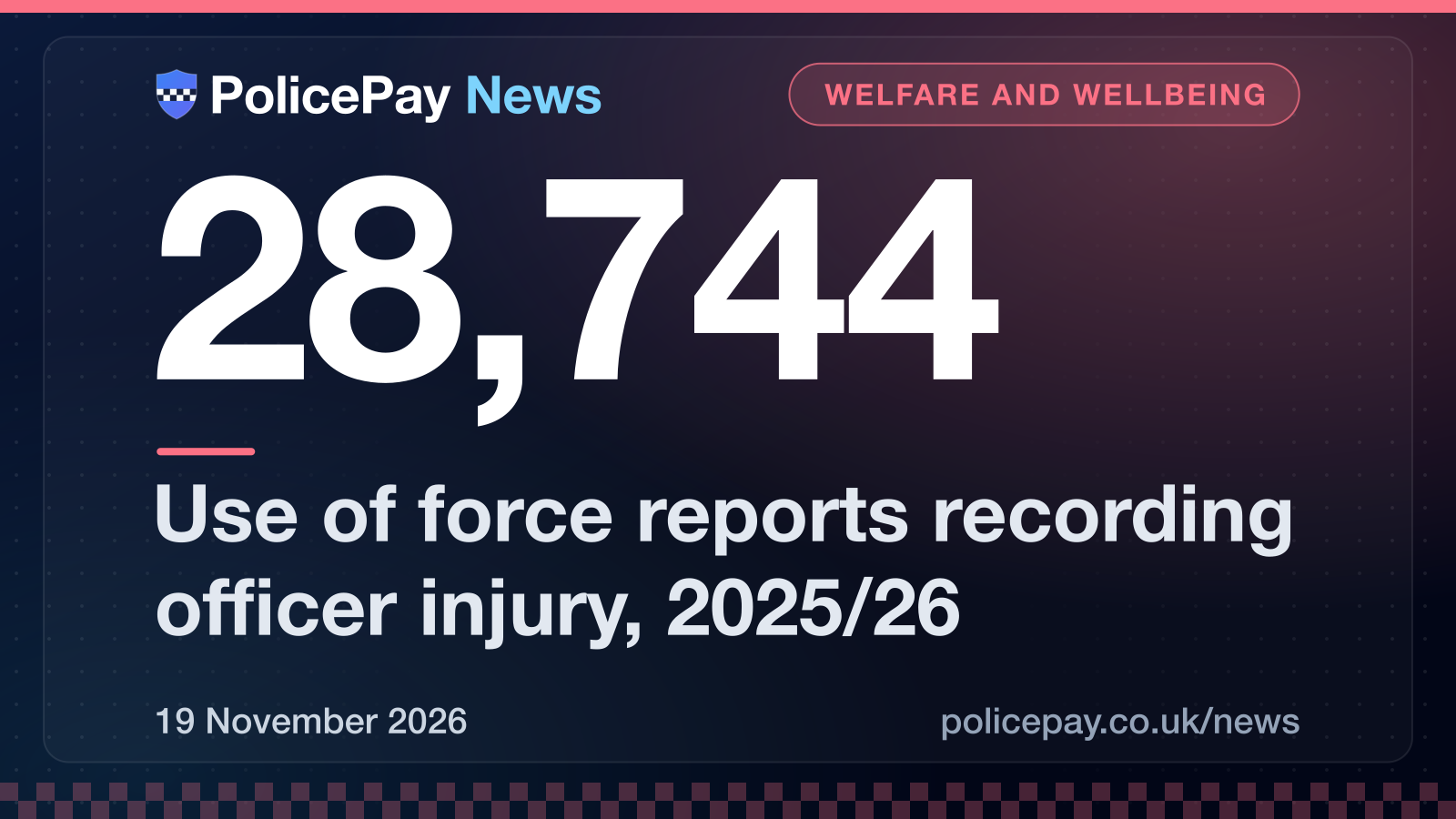
Officer injury recorded in 28,744 police use of force reports in 2025/26
Home Office figures for April 2025 to March 2026 show officers recorded an injury to themselves in 3% of use of force reports. Here is what the numbers show, how far to read into them and what to do if you are hurt at work.
What it means for you
- Injury to the officer was recorded in 3% of use of force reports, the same share as the year before. The count rose because more use of force was recorded overall.
- Most recorded officer injuries were minor. Where the level was recorded, 98% were minor and 2% severe, the same split as the year before.
- Report any injury the same day, however minor it seems. The record you make now can matter years later if you ever need an injury award.
- Support does not depend on being injured. Ask your force about post-incident support and speak to your Federation or union rep. The Oscar Kilo crisis line (0300 131 2789) and Samaritans (116 123) are there if you are struggling.
This is a planned look at official figures rather than breaking news. The Home Office's police use of force statistics for April 2025 to March 2026, published on 15 October 2026, show injury to the officer was recorded in 28,744 use of force reports. That is 3% of the 866,471 reports made in the year by the 43 forces in England and Wales and the British Transport Police. The year before, officer injury was recorded in 27,496 reports, also 3%. That is 1,248 more, a rise of 4.5% by our calculation.
Officer injury in use of force reports, 2025/26
- 28,744 Reports recording injury to the officer Home Office, 3% of reports
- 555 Severe injuries, where the level was recorded Home Office, 2%
- 41,298 Reports recording an assault on the officer Home Office, 16,557 led to injury
In April 2025 to March 2026, injury to the officer was recorded in 28,744 use of force reports, 3% of the total. Where the level of injury was recorded, 555 (2%) were severe. Assault on the officer was recorded in 41,298 reports, of which 16,557 led to injury.
Each report covers one officer's use of force on one person, so the figures count reports, not officers or incidents. If two officers use force on the same person, two reports are made. The Home Office says the 7% rise in use of force reports may reflect better recording as well as more police activity: arrests rose 2% (excluding Derbyshire) and stop and searches 11% in the same year.
What the figures show
Officer injury has been recorded in a rising number of reports over the last three years: 24,295 in the year to March 2024, 27,496 in the year to March 2025 and 28,744 in the year to March 2026. Over the same period the total number of use of force reports also rose, from 747,396 to 812,447 and then 866,471, so the share stayed at about 3% each year.
Use of force reports recording injury to the officer
Use of force reports recording injury to the officer: year to March 2024 24,295; year to March 2025 27,496; year to March 2026 28,744. About 3% of all reports each year.
Where the level of injury was recorded in 2025/26, 98% (24,482) were minor and 2% (555) were severe. The Home Office defines a severe injury as a fracture, deep cut, deep laceration, internal organ damage, impairment of any bodily function or an injury that may need formal admission to hospital. The year before, 410 severe injuries were recorded. The level of injury was recorded in more reports in 2025/26 (25,037 against 19,999, by our calculation), so the higher count of severe injuries should be read alongside that. The 2% share did not change.
Officers also record whether they were assaulted during the incident. Assault was recorded in 41,298 reports in 2025/26, up from 39,072. Of those, 16,557 (40%) led to injury to the officer, against 16,176 (41%) the year before.
Why officers used force
The most common reason officers gave for using force was to protect themselves from violence, recorded in 520,500 reports (60%). Assisting an arrest was recorded in 464,028 reports (54%) and protecting other officers from violence in 430,302 reports (50%). More than one reason can be recorded. Alcohol was the most common impact factor (35%), followed by the size, gender or build of the person (33%) and drugs (32%).
These figures are not the same as recorded crime. Our report on recorded assaults on constables uses ONS crime tables, which count offences whether or not force was used. The two should not be added together or compared directly.
If you are hurt at work
Get treatment first, then tell your supervisor, complete your force's injury or accident report and make a notebook entry. Our guide to what to do after an injury on duty goes through each step, including sick pay and the evidence worth keeping. Our guide to what counts as an injury on duty explains the legal test. The restricted and adjusted duties guide covers coming back to work.
An incident can affect you even when there is no physical injury. Our guide to TRiM and post-incident support explains what to ask your force for. The mental health support directory lists the national services. Those include Oscar Kilo and Police Care UK, which supports serving and former officers, staff and volunteers harmed by policing as well as their families. Police Care UK is not a crisis service. Samaritans answer at any time on 116 123.
Sources
- Home Office, Police use of force statistics: April 2025 to March 2026 (15 October 2026). 866,471 use of force reports in the year ending 31 March 2026, a 7% increase; 43 forces plus the British Transport Police; arrests up 2% and stop and searches up 11%. Section 8.1: injury to the officer recorded in 3% (28,744) of reports; where the level was recorded, 98% (24,482) minor and 2% (555) severe; assault recorded in 5% (41,298) of reports, of which 40% (16,557) resulted in injury to the officer. Severe injury definition in section 8. Section 5: protect themselves from violence 60% (520,500), assist arrest 54% (464,028), protect other officers 50% (430,302); alcohol 35%, size, gender or build 33%, drugs 32%. Accessed 19 November 2026.
- Home Office, Police use of force statistics, England and Wales: April 2024 to March 2025. 812,447 use of force reports. Section 8.1 text: injury to the officer recorded in 3% (27,496) of reports; where the level was recorded, 98% (19,589) minor and 2% (410) severe; assault recorded in 5% (39,072) of reports, of which 41% (16,176) resulted in injury. (The section 8.1 heading on that page says 5%; its text and figures give 3%.) Accessed 19 November 2026.
- Home Office, Police use of force statistics, England and Wales: April 2023 to March 2024. Of 747,396 use of force reports, 24,295 (3%) reported injury to the officer. Accessed 19 November 2026.
- Oscar Kilo, Confidential Mental Health Crisis Line extended to those who have left policing. Crisis line for people who work or have worked in policing. Accessed 19 November 2026.
- Police Care UK, We're here to help you. Supports serving and veteran police officers and staff, volunteers and their families harmed by policing; says it is not equipped to provide crisis support. Accessed 19 November 2026.
- Samaritans. Free support at any time on 116 123. Accessed 19 November 2026.
Corrections
No corrections to this article.
If we get something wrong, we fix it, add a dated correction here, update the time above and record it in our public corrections log. To report an error, email andrew@policepay.co.uk or use the contact page with the figure and your source. This article is general information, not financial or legal advice.
About this article
Written by Andrew Thomas, Founder, PolicePay. Before publishing, every figure and claim was checked against the primary sources above in a separate, independent check. Articles are not published until that check passes. Read About Police Pay News for how we choose stories, check facts, use AI tools and stay independent. Our news standards set the rules.