Police staff annual leave by force: where the 2026 pay offer would add a day
The 2026 police staff pay offer would raise the minimum annual leave from 24 to 25 days on appointment and from 29 to 30 days after five years, from 1 April 2027. UNISON's force-by-force table shows staff in 23 of the 35 Police Staff Council forces it lists would gain, by our count. It is an offer, not a deal: UNISON's ballot closes on 19 November.
What it means for you
- If the 2026 offer is agreed, the minimum annual leave for police staff in Police Staff Council forces rises from 24 to 25 days on appointment and from 29 to 30 days after five years' service, from 1 April 2027.
- It only changes your leave if your force currently gives you less than the new minimum. UNISON's table shows that is true for some or all staff in 23 of the 35 Police Staff Council forces it lists, by our count.
- Where a force has different leave for different grades, it is usually the lowest grades that are on the minimum, though in some forces several grades are on 29 days after five years. Not everyone in a listed force would gain.
- Nothing changes yet. UNISON recommends members vote to accept and its ballot closes at 12 noon on 19 November. If you are a member, check your force's row and vote before the deadline.
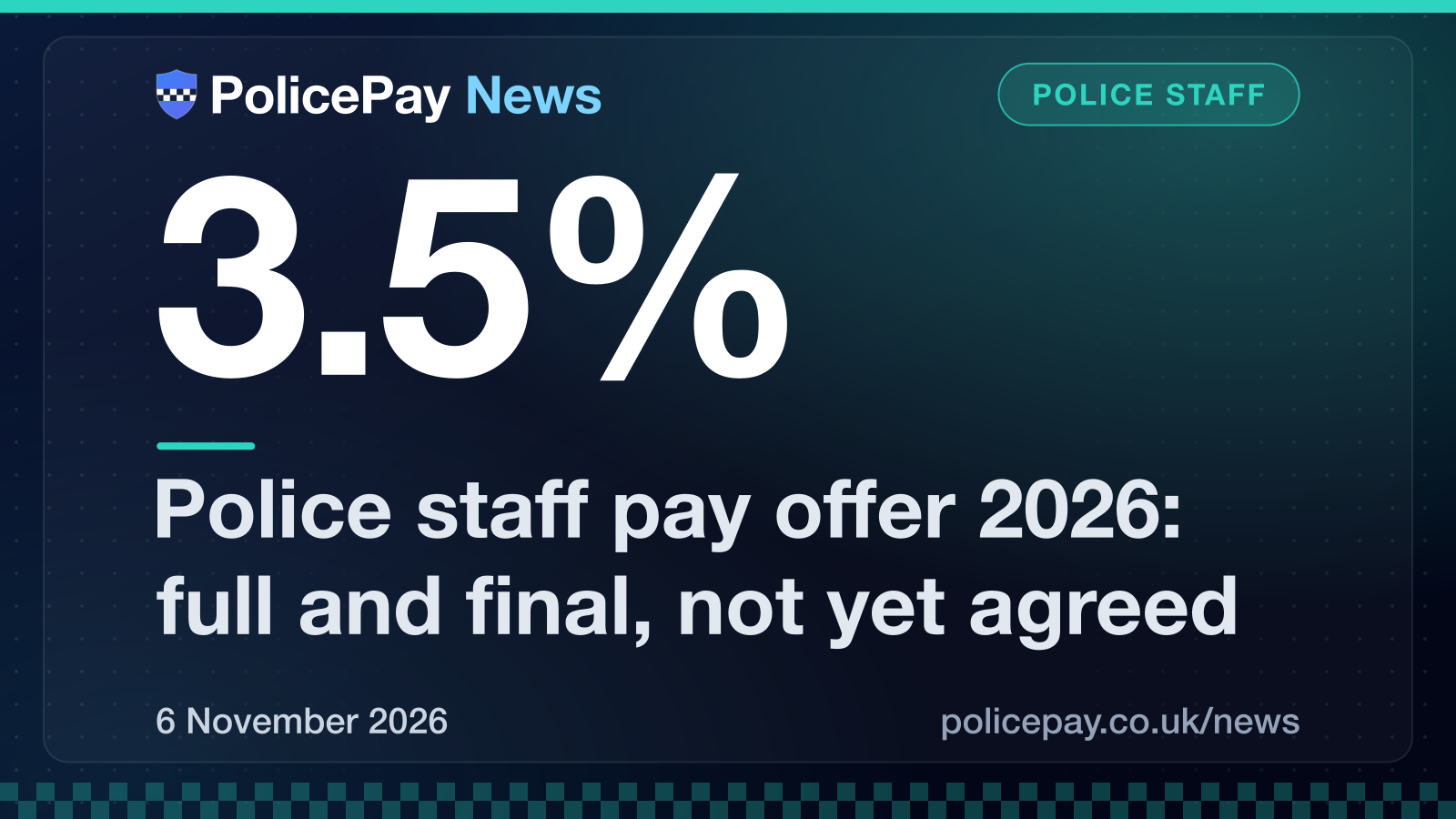
The 2026 pay offer to police staff is not only about the 3.5% rise. It also raises the minimum annual leave in the Police Staff Council Handbook by one day: from 24 to 25 days on appointment and from 29 to 30 days after five years' service, taking effect from 1 April 2027. UNISON has published a table of police staff annual leave entitlement by force, dated November 2026, which shows where staff are currently on the minimum and so would gain the extra day if the offer is agreed.
The leave part of the 2026 offer
- 25 days Proposed minimum on appointment, up from 24 UNISON, offer 2026
- 30 days Proposed minimum after five years, up from 29 UNISON, offer 2026
- 23 of 35 PSC forces in UNISON's table where some staff would gain UNISON table, by our count
The 2026 police staff pay offer would raise the minimum annual leave from 24 to 25 days on appointment and from 29 to 30 days after five years, from 1 April 2027. By our count, staff in 23 of 35 Police Staff Council forces in UNISON's table would gain.
By our count, UNISON's table lists 35 forces covered by the Police Staff Council (Norfolk and Suffolk share one row, which we count as two forces). In 23 of 35 of them, some or all police staff are on less than the proposed new minimum, so they would get at least one more day. In the other 12, every grade already gets at least 25 days on appointment and 30 days after five years.
Forces where some or all staff would gain
UNISON highlights these forces as ones whose staff would benefit from the higher minimum:
- Same leave for all grades: Cambridgeshire, Cleveland, Cumbria, Dyfed Powys, Essex, Gloucestershire, Lincolnshire, North Wales, Nottinghamshire, South Wales and West Mercia.
- Leave that varies by grade (usually the lowest grades gain; in some forces more grades gain after five years): Avon and Somerset, Bedfordshire, Cheshire, Derbyshire, Gwent, Hampshire and Isle of Wight, Hertfordshire, Leicestershire, Norfolk, Suffolk, Sussex and West Midlands.
Most of these start staff on 24 days. Two are different. Cambridgeshire already gives 28 days on appointment but 29 after five years, so its staff would gain only after five years. North Wales gives 25 days on appointment but 29 at five and ten years' service, so the gain there is for staff with between five and 15 years' service. In Hampshire and Isle of Wight, staff at all four grade levels in UNISON's table stay on 29 days at five, ten and 15 years' service. The two lowest levels there also start on 24 days. The new minimums would apply to them.
Forces already at or above the new minimum
In these forces the table shows every grade already on at least 25 days on appointment and 30 days after five years: Devon and Cornwall, Dorset, Durham, Lancashire, Merseyside, Northumbria, North Yorkshire, Wiltshire, Humberside, South Yorkshire, Staffordshire and West Yorkshire. Among Police Staff Council forces, the highest starting figure for the lowest grade is Cambridgeshire's 28 days, followed by South Yorkshire's 27.
Leave on appointment for the lowest grade, PSC forces
Among the 35 Police Staff Council forces in UNISON's table, the lowest grade starts on 24 days in 21 forces, 25 days in 9, 26 days in 3, 27 days in 1 and 28 days in 1.
On appointment, by our count, 21 forces start their lowest grade on 24 days, 9 on 25 days, 3 on 26 days, 1 on 27 days and 1 on 28 days.
Forces the offer does not cover
UNISON's table also shows Police Scotland, Kent, Surrey and Thames Valley. It notes that they are not part of the Police Staff Council and so are not covered by this offer. The table does not list Greater Manchester, Northamptonshire, Warwickshire, the Metropolitan Police or City of London Police, so if you work there check your own force's policy. Your contract or force policy sets out your exact entitlement.
Minimum police staff annual leave: now and under the offer
Current minimum
24 days
- On appointment
- 29 days after five years
Under the offer
25 days
- On appointment
- 30 days after five years
- From 1 April 2027, if agreed
The current Police Staff Council minimum is 24 days on appointment and 29 days after five years. Under the 2026 offer it would be 25 days on appointment and 30 days after five years, from 1 April 2027, if agreed.
What happens next
The offer is the employers' full and final offer, not an agreed deal. UNISON is recommending that its members vote to accept. Its ballot closes at 12 noon on 19 November. If the offer is agreed, the leave change would apply from 1 April 2027.
For the pay side of the offer, our police staff pay rise calculator shows what 3.5% means on your salary after tax. The police staff pay rise 2026 tracker will be updated with the ballot result. Our guide to UNISON, GMB and Unite explains how the ballot works. The police staff pay scales 2026/27 page shows every pay point.
Sources
- UNISON, Police staff pay offer 2026. The offer: 3.5% on all pay points from 1 September 2026; minimum annual leave in the Police Staff Council Handbook from 24 to 25 days on appointment and 29 to 30 days after five years' service, from 1 April 2027. UNISON recommends members vote to accept; its ballot closes at 12 noon on 19 November. The page links to the police staff annual leave tables. Accessed 16 November 2026.
- UNISON, Police Staff Annual Leave Entitlement by Force (November 2026, Word document). Annual leave by force and length of service, with forces whose staff would benefit from the higher minimum highlighted. Police Scotland, Kent, Surrey and Thames Valley are marked as not part of the Police Staff Council. Starting leave for the lowest grade: 24 days in 21 forces, 25 days in 9, 26 days in 3, 27 days in 1 (South Yorkshire) and 28 days in 1 (Cambridgeshire); counts by our calculation, with Norfolk and Suffolk counted as two forces. Accessed 16 November 2026.
- Police Staff Council Employers' Side, Pay Offer 2026 (letter to the Trade Union Side, 27 October 2026). The employers' full and final offer, including the minimum annual leave increase from 1 April 2027. Linked from UNISON's pay offer page. Accessed 16 November 2026.
- Police Staff Council Employers' Side, EMP circular 3/2026, Police staff pay 2026 (5 November 2026). The full and final offer, including the minimum annual leave change from 1 April 2027. The consultative ballot runs from 5 November to 19 November. Accessed 6 November 2026.
Corrections
No corrections to this article.
If we get something wrong, we fix it, add a dated correction here, update the time above and record it in our public corrections log. To report an error, email andrew@policepay.co.uk or use the contact page with the figure and your source. This article is general information, not financial or legal advice.
About this article
Written by Andrew Thomas, Founder, PolicePay. Before publishing, every figure and claim was checked against the primary sources above in a separate, independent check. Articles are not published until that check passes. Read About Police Pay News for how we choose stories, check facts, use AI tools and stay independent. Our news standards set the rules.