Recorded assaults on constables reach 49,111 in the year to June 2026
Official figures show assaults without injury on constables rose 5.6% while assaults with injury fell 2.3%. Here is what the numbers show, how far to trust them and what to do if it happens to you.
What it means for you
- An assault on you at work is a crime. If it happens, make sure the offence is recorded, whether or not you were physically hurt.
- Report any injury the same day, however minor it seems. The record you make now can matter years later if you need an injury award.
- The rise is in assaults without injury. These are recorded crime counts, so they can move with reporting and recording as well as with what happens on the street.
- Support does not depend on being injured. Ask your force about post-incident support and speak to your Federation or union rep. The Oscar Kilo crisis line (0300 131 2789) and Samaritans (116 123) are there if you are struggling.
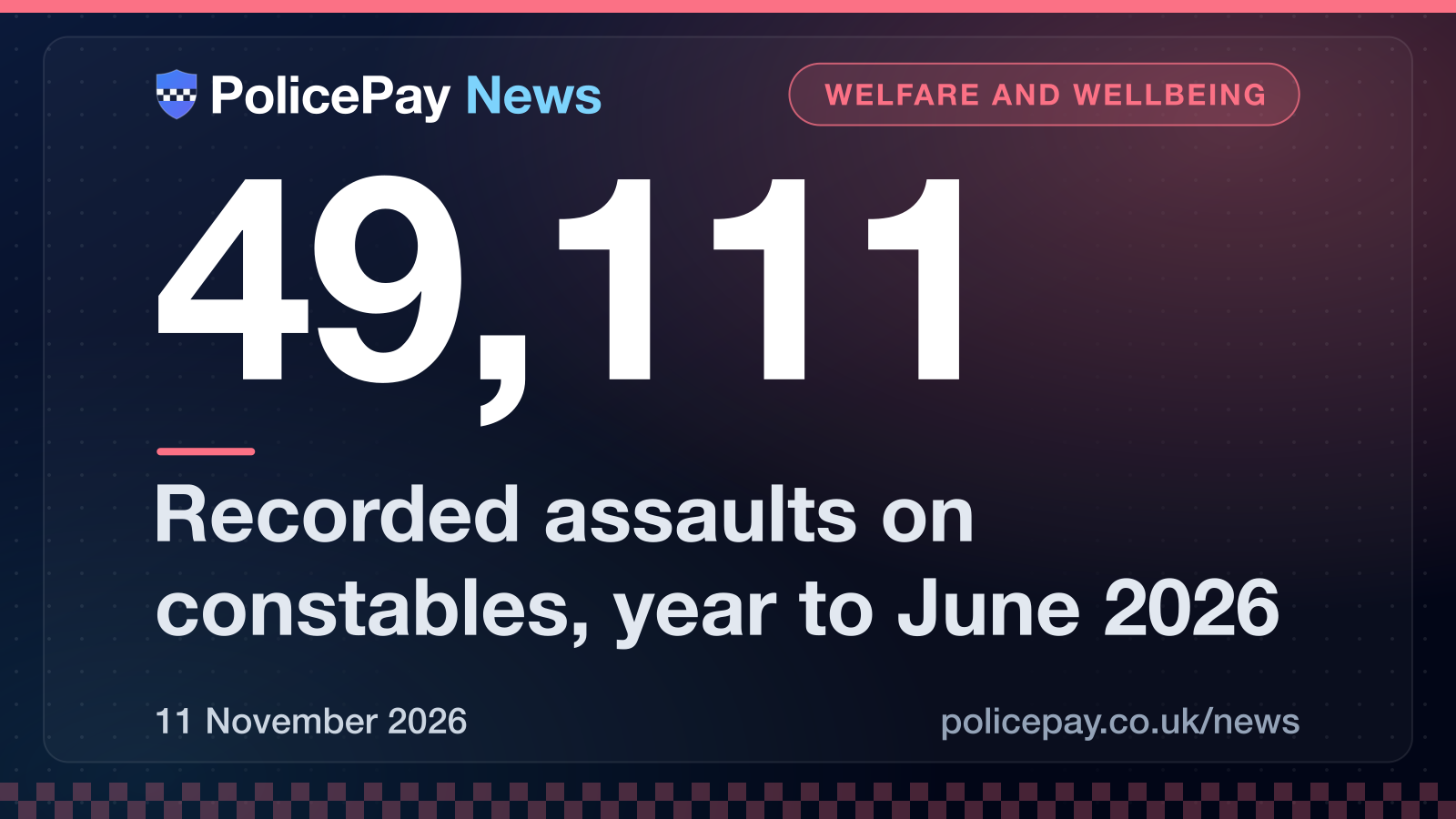
This is a planned look at official figures rather than breaking news. Police in England and Wales recorded 49,111 assaults on constables in the year to June 2026, up from 47,315 in the year to June 2025. That is 1,796 more, a rise of 3.8% by our calculation. The total works out at about 135 a day. In law, every sworn police officer holds the office of constable, so these categories are not limited to the rank of constable. The figures are in the appendix tables the Office for National Statistics (ONS) published with its crime release on 22 October 2026. The totals are ours: we added together two offence categories that the ONS lists separately.
Recorded assaults on constables, year to June 2026
- 49,111 Both categories together By our calculation, up 3.8%
- 38,515 Assault without injury ONS, up 5.6%
- 10,596 Assault with injury ONS, down 2.3%
In the year to June 2026 there were 49,111 recorded assaults on constables in England and Wales, up 3.8% by our calculation. 38,515 were without injury, up 5.6%. 10,596 were with injury, down 2.3%.
What the figures show
The two categories moved in opposite directions. Assault without injury on a constable rose 5.6% to 38,515. Assault with injury on a constable fell 2.3% to 10,596. So about 78% of the recorded offences, by our calculation, were without injury.
Over a longer period the recorded total has climbed. It was 31,030 in the year to March 2019 and 48,222 in the year to March 2026, which is 55% higher by our calculation. We start there because the separate with-injury category began only in April 2017, so we leave out its first year.
Recorded assaults on constables by year
Recorded assaults on constables, with and without injury added together: year to March 2019 31,030; 2020 33,279; 2021 38,278; 2022 41,638; 2023 40,568; 2024 46,182; 2025 47,519; 2026 48,222; year to June 2026 49,111.
Within the latest 12 months, the highest month was August 2025 with 4,532 offences and the lowest was February 2026 with 3,483, again adding the two categories. Assault with injury on an emergency worker other than a constable is counted separately. That stood at 4,488, down 2.3%.
How far to trust the numbers
Three cautions apply. First, the ONS says police recorded crime is "not always a good indicator of general trends in crime" because recording changes over time. The tables are labelled official statistics, not accredited official statistics. A rise can reflect more offences being reported or recorded as well as more assaults taking place.
Second, these are offences, not officers. One officer can be assaulted more than once. For scale, there were 145,886 full-time equivalent officers in the 43 territorial forces at 31 March 2026. That is roughly one recorded offence for every three officers by our calculation, but only as a rough guide: the two figures cover different periods and the ONS note on these tables says the crime data includes the British Transport Police.
Third, other official counts give different numbers because they measure something else. In the Home Office's use of force statistics for April 2025 to March 2026, officers recorded an assault in 41,298 reports, 16,557 of which led to injury to the officer. Those figures cover only incidents where force was used, so they should not be added to or compared directly with the ONS totals.
If you are assaulted at work
Get treatment first, then tell your supervisor, complete your force's injury or accident report and make a notebook entry. Our guide to what to do after an injury on duty goes through each step, including sick pay and the evidence worth keeping. Our guide to what counts as an injury on duty explains the test. The compensation routes guide compares the options that can sit alongside an award.
An assault can affect you even when there is no physical injury. Our guide to TRiM and post-incident support explains what to ask your force for. The mental health support directory lists the national services. Those include Oscar Kilo and Police Care UK, which supports serving and former officers, staff and volunteers harmed by policing as well as their families. It is not a crisis service. Samaritans answer at any time on 116 123.
Sources
- ONS, Crime in England and Wales: Appendix tables, year ending June 2026 (Tables A5a and A5b). Released 22 October 2026. Assault without injury on a constable (offence code 104): 38,515 in the year to June 2026, 36,469 the year before, up 5.6%. Assault with injury on a constable (8S): 10,596, against 10,846, down 2.3%. Assault with injury on an emergency worker other than a constable (8T): 4,488, down 2.3%. Combined totals by our calculation: year to March 2019 31,030; 2020 33,279; 2021 38,278; 2022 41,638; 2023 40,568; 2024 46,182; 2025 47,519; 2026 48,222; year to June 2025 47,315; year to June 2026 49,111. Monthly combined figures are from Table A5b. 8S was introduced from April 2017. Note 2 says all 43 forces including the British Transport Police; the bulletin says 43 forces plus the British Transport Police; the table says official statistics, not accredited official statistics. Accessed 6 November 2026.
- ONS, Crime in England and Wales: year ending June 2026 (statistical bulletin, 22 October 2026). Police recorded crime is not always a good indicator of general trends in crime, because of changes in how it is recorded over time. Next release 28 January 2027. Accessed 6 November 2026.
- Home Office, Police workforce, England and Wales: 31 March 2026. 145,886 FTE police officers in the 43 territorial police forces at 31 March 2026. Accessed 6 November 2026.
- Home Office, Police use of force statistics: April 2025 to March 2026 (15 October 2026). Assault recorded in 41,298 use of force reports, of which 16,557 resulted in injury to the officer. Accessed 6 November 2026.
- Oscar Kilo, Confidential Mental Health Crisis Line extended to those who have left policing. Crisis line for people who work or have worked in policing. Accessed 6 November 2026.
- Police Care UK. Supports serving and veteran police officers and staff, volunteers and their families who have suffered harm as a result of policing. Accessed 11 November 2026.
- Police Care UK, We're here to help you. Police Care UK says it is not equipped to provide crisis support. Accessed 11 November 2026.
- Samaritans. Free support at any time on 116 123. Accessed 6 November 2026.
Corrections
No corrections to this article.
If we get something wrong, we fix it, add a dated correction here, update the time above and record it in our public corrections log. To report an error, email andrew@policepay.co.uk or use the contact page with the figure and your source. This article is general information, not financial or legal advice.
About this article
Written by Andrew Thomas, Founder, PolicePay. Before publishing, every figure and claim was checked against the primary sources above in a separate, independent check. Articles are not published until that check passes. Read About Police Pay News for how we choose stories, check facts, use AI tools and stay independent. Our news standards set the rules.