Police accountability review asks officers and staff for evidence by 15 January 2027
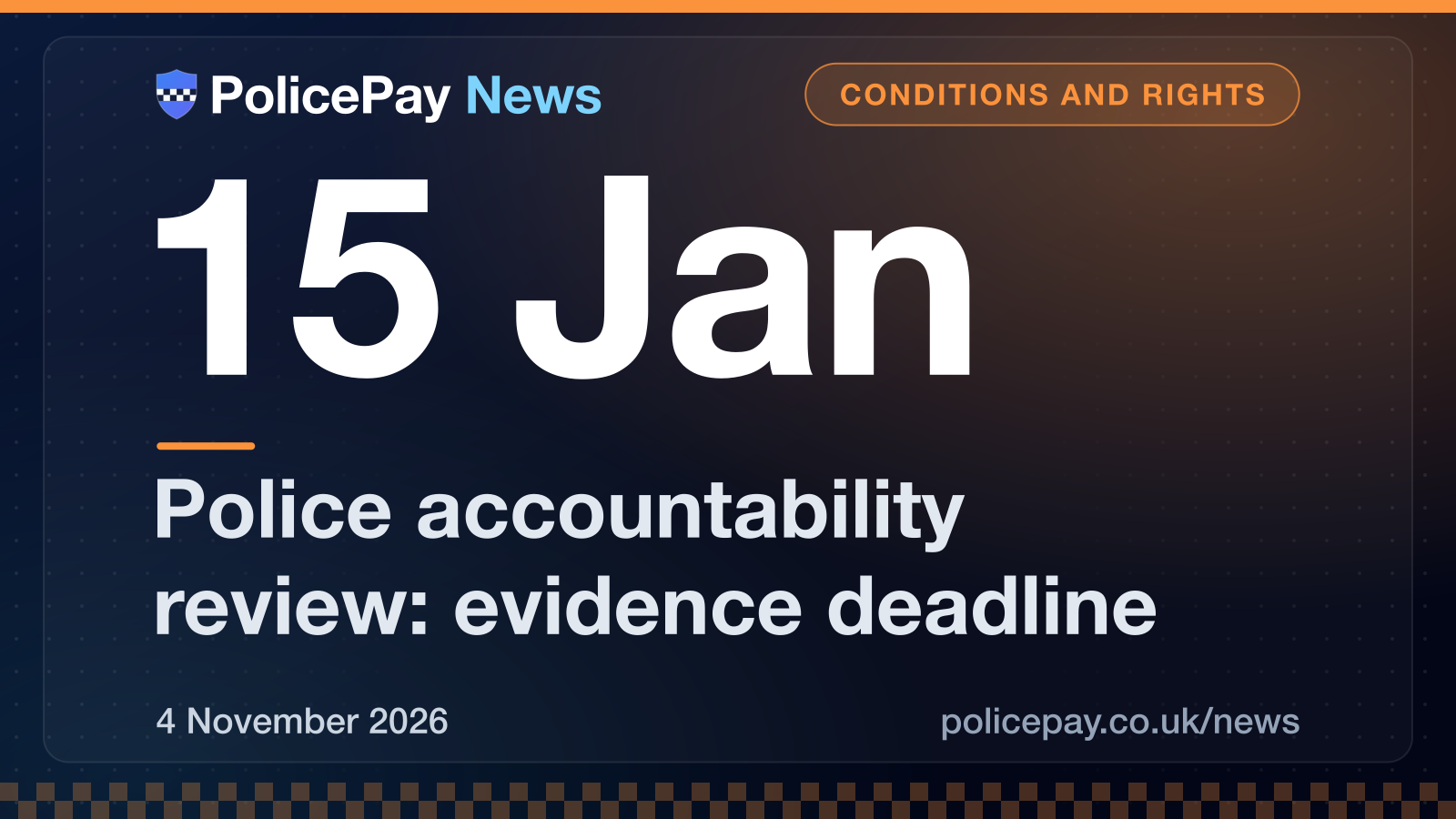
The independent end-to-end review of the police accountability system, chaired by Dame Lynne Owens and Jason Beer KC, opened a call for evidence on 4 November 2026. Serving and former officers and staff can respond until 15 January 2027.
What it means for you
- You can give evidence on how the complaints and misconduct system works, including delays, as a serving or former officer or member of police staff. The deadline is 11:59pm on 15 January 2027.
- No question is compulsory. You can answer as much or as little as you like, online or by email.
- The review cannot investigate, intervene in or advise on individual cases. If you mention your own case, focus on the wider issue it shows and do not name people. Do not ask for a case to be reviewed or send documents about a live matter.
- Nothing changes yet. The review makes recommendations to the Home Secretary and Lord Chancellor; any change to the rules would come later.
The independent end-to-end review of the police accountability system opened a call for evidence at 12pm on 4 November 2026. It closes at 11:59pm on 15 January 2027. The review is chaired by Dame Lynne Owens and Jason Beer KC and covers England and Wales. The call for evidence is published by the Home Office and the Ministry of Justice.
The call for evidence names police officers and staff among the people it wants to hear from, alongside members of the public, victims, bereaved families, forces, oversight bodies, legal professionals, academics and representative organisations. The response form lets you say whether you are a serving or former police officer, serving or former police staff, or part of a professional standards department, staff association or trade union.
The police accountability review so far
- 30 July 2026 Review launched Chaired by Dame Lynne Owens and Jason Beer KC.
- 4 November 2026 Now Call for evidence opens Online survey or email; no question is mandatory.
- 15 January 2027 Expected Call for evidence closes At 11:59pm.
- Within 6 months Expected Findings to ministers The terms of reference say within 6 months; no date has been set. The Home Secretary has committed to publishing a response.
Timeline of the police accountability review: launched on 30 July 2026; call for evidence opened on 4 November 2026; it closes at 11:59pm on 15 January 2027; the chairs give findings to the Home Secretary and Lord Chancellor within 6 months; the Home Secretary has committed to publishing a response.
What the review is for
The government launched the review on 30 July 2026. Its terms of reference ask the chairs to assess the systemic issues in the end-to-end system for holding police to account and to recommend reforms with four aims:
- improving public confidence in the system, including that of victims and witnesses;
- improving the confidence of police officers so that they are and feel supported to perform well;
- creating a speedier, simpler and more effective accountability regime;
- separating individual and organisational accountability more precisely, with a route for each.
The review must look at what causes delay for victims, families and officers, whether the powers of the Independent Office for Police Conduct (IOPC), local professional standards departments and local policing bodies are adequate, how open the system is and how it fits with the criminal, coronial and civil justice systems. It must also look at the criteria for deciding whether an investigation starts and which body carries it out. The terms of reference say the chairs will give their findings to the Home Secretary and Lord Chancellor within 6 months. The Home Secretary has committed to publishing a response.
When it announced the review, the Home Office said lengthy investigations can mean officers found to have done nothing wrong are kept away from front line duties for too long. Our guide to how long police misconduct investigations take sets out the current time limits and the official figures.
How long cases take now
The latest Home Office police misconduct statistics, for cases finalised in the year to 31 March 2025, show a median of 210 days from a case being received to it being finalised. Cases that went to a misconduct meeting or hearing took a median of 478 days; cases that did not took 140 days.
How long misconduct cases take now
- 210 days Median, all cases finalised in 2024/25 Home Office
- 478 days Median where a meeting or hearing was held Home Office
- 140 days Median where there was no meeting or hearing Home Office
Home Office figures for misconduct cases finalised in the year to 31 March 2025: a median of 210 days from receipt to finalisation; 478 days for cases that went to a misconduct meeting or hearing; 140 days for cases that did not.
Delay is one of the eight sections of the questions. The others cover the purpose of the system, how matters enter it, how decisions are made, the powers and roles of the bodies involved, openness and learning, how it works with other justice processes such as inquests and employment tribunals, lessons from other professions and further evidence, including what a future system should look like. One question asks whether the system should prioritise learning and improvement or disciplinary action; others ask you to choose between speed and thoroughness or between local decision making and independent oversight.
A separate set of questions is for serving and former officers and staff. It asks whether you have ever been subject to a complaint, a misconduct investigation or a performance process. If you have, our guide to your rights when under investigation explains the current process.
How to respond
- Use the online survey linked from the GOV.UK call for evidence page, or download the questions and email your answers to policeaccountabilityreview@homeoffice.gov.uk.
- Answer only the questions you want to. The page says none of them are mandatory.
- Leave out personal data where you can. Do not ask the review to look at a particular case or send documents about an ongoing matter. The review says it cannot investigate, intervene in or advise on individual complaints, misconduct matters, criminal cases or legal proceedings. If you refer to a case, explain the wider issue it shows rather than naming people.
- Send it by 11:59pm on 15 January 2027.
The review is not seeking views on the Ministry of Justice's separate consultation on the standard of proof for a conclusion of unlawful killing.
If you are going through a complaint or investigation now, the review will not change your case. Your Federation representative, staff association or union is the first place to go for advice. Our police misconduct hub covers each stage. Our guide to IOPC investigations explains when the IOPC is involved. Being investigated can be stressful: confidential support, including Police Care UK and the Samaritans (116 123), is in our police mental health support directory.
Sources
- GOV.UK, Police accountability: call for evidence (Home Office and Ministry of Justice, published 4 November 2026). Opens 12pm on 4 November 2026 and closes 11:59pm on 15 January 2027; England and Wales; chaired by Dame Lynne Owens and Jason Beer KC; who can respond (including police officers and staff); online survey or email to policeaccountabilityreview@homeoffice.gov.uk; no question mandatory; avoid personal data and documents about ongoing matters; the review cannot investigate, intervene in or advise on individual complaints, misconduct matters, criminal cases or legal proceedings; not seeking views on the Ministry of Justice consultation on the standard of proof for unlawful killing. Accessed 4 November 2026.
- Police accountability review: call for evidence questions (downloadable, GOV.UK, 4 November 2026). Stakeholder options (serving and former police officer and staff, professional standards department, staff association, trade union); questions for officers and staff on whether they have been subject to a complaint, misconduct investigation or performance process; Sections 1 to 8 (purpose and effectiveness; entry to the system; decision making; timeliness; powers, roles and governance; openness and learning; other justice systems including coronial processes and employment tribunals; further evidence); trade-off questions on learning or discipline, speed or thoroughness and local decision making or independent oversight. Accessed 4 November 2026.
- GOV.UK, End-to-end review of the police accountability system: terms of reference (30 July 2026). The four intents; scope (timeliness, IOPC, PSD and local policing body powers, openness, criminal, coronial and civil systems, criteria for starting investigations and which body investigates); findings to the Home Secretary and Lord Chancellor within 6 months. The publication page (https://www.gov.uk/government/publications/end-to-end-review-of-the-police-accountability-system) adds that the Home Secretary has committed to publishing a response. Accessed 4 November 2026.
- GOV.UK news, Police misconduct processes to be reviewed (Home Office, 30 July 2026). Launch of the review on 30 July 2026; lengthy investigations can mean officers found to have done nothing wrong are kept away from front line duties for too long. Accessed 4 November 2026.
- Home Office, Police misconduct, England and Wales: year ending 31 March 2025 (published 22 January 2026). Timeliness chapter: median 210 days from receipt to finalisation for cases finalised in the year; 478 days for cases that went to a misconduct meeting or hearing; 140 days for cases that did not. Accessed 4 November 2026.
Corrections
No corrections to this article.
If we get something wrong, we fix it, add a dated correction here, update the time above and record it in our public corrections log. To report an error, email andrew@policepay.co.uk or use the contact page with the figure and your source. This article is general information, not financial or legal advice.
About this article
Written by Andrew Thomas, Founder, PolicePay. Before publishing, every figure and claim was checked against the primary sources above in a separate, independent check. Articles are not published until that check passes. Read About Police Pay News for how we choose stories, check facts, use AI tools and stay independent. Our news standards set the rules.