Police barred list: 757 officers added in 2025-26, more than half after they had left
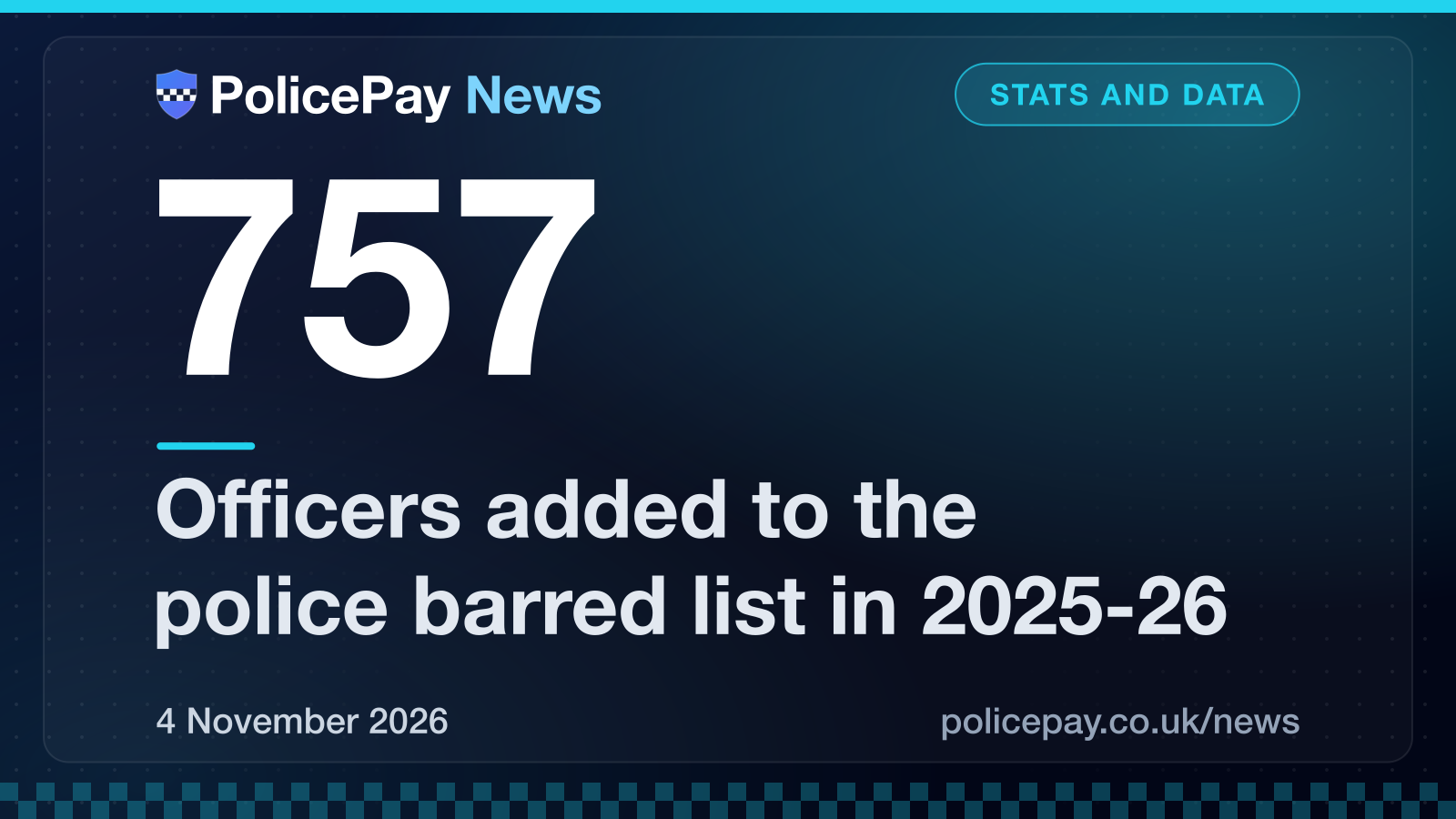
The College of Policing's latest dismissals report shows 757 regular officers were placed on the barred list in the year to 31 March 2026, up from 735. 423 of them had already resigned or retired. Here is what the figures show and what they mean for you.
What it means for you
- Resigning or retiring does not take you out of the system: 423 of the 757 officers added were dismissed after they had already left the force.
- Police staff placements rose faster than officer placements: 348 staff were added, up from 280 the year before.
- Being placed on the barred list does not by itself take away pension you have already built up. Forfeiture under the pension scheme rules needs a qualifying criminal conviction; in limited cases money owed to the Crown or your employer, or a loss to the scheme, can be recovered from benefits.
- If you are under investigation, get advice from your Federation representative, union or solicitor before you decide whether to resign.
The College of Policing published its annual report Police dismissals (Home Office forces) 2025 to 2026 on 3 November 2026. It counts everyone placed on the police barred list after being dismissed, or found that they would have been dismissed, between 1 April 2025 and 31 March 2026. It covers the 43 Home Office forces in England and Wales; British Transport Police, the Ministry of Defence Police and the Civil Nuclear Constabulary are not included.
The barred list in 2025-26 at a glance
- 757 Regular officers added, year to 31 March 2026 College of Policing
- 423 Of those, dismissed after resigning or retiring College of Policing
- 348 Police staff added College of Policing
- 3,591 Regular officers added since December 2017 College of Policing
Four figures from the College of Policing's 2025 to 2026 dismissals report. 757 regular officers were added to the barred list in the year to 31 March 2026. 423 of them were dismissed after resigning or retiring. 348 police staff were added. 3,591 regular officers have been added since December 2017.
The headline numbers
757 regular police officers were placed on the barred list in the year, compared with 735 the year before: a rise of 3% by our calculation. 25 members of the Special Constabulary were also added (31 the year before), along with 348 members of police staff (280 the year before, a rise of 24% by our calculation).
Since the barred list began on 15 December 2017, 3,591 regular officers, 248 special constables and 1,616 police staff have been added to it.
The College's year by year table shows how the yearly number of officers has grown: 299 in 2021-22, 394 in 2022-23, 594 in 2023-24, 735 in 2024-25 and 757 in 2025-26. The rise this year is much smaller than in the two years before.
Regular officers added to the barred list each year
Bar chart of regular police officers added to the barred list in each year ending 31 March: 2021-22 299; 2022-23 394; 2023-24 594; 2024-25 735; 2025-26 757.
More than half had already left
Of the 757 officers, 334 were dismissed while serving. 397 were dismissed after they had resigned and 26 after they had retired. That makes 423 who had already left the force, 56% of the total by our calculation.
Status when dismissed, regular officers 2025-26
Dismissed while serving
334
- Still in the force at the hearing
After resigning
397
- Proceedings continued after they left
After retiring
26
- Found they would have been dismissed
Of the 757 regular officers added to the barred list in 2025-26, 334 were dismissed while serving, 397 after resigning and 26 after retiring.
This follows from the rules. Since 2017, officers may resign or retire while under investigation for gross misconduct, but forces can continue the proceedings after they leave and find that they would have been dismissed. That finding puts them on the barred list in the same way as a dismissal while serving. Our guide to resigning before a misconduct hearing explains how this works. For police staff it is different: the report says nothing prevents staff from leaving while under investigation for gross misconduct and forces are under no regulatory obligation to hold post-employment hearings for them.
By rank, 641 of the officers were constables, 84 were sergeants and 18 were inspectors.
Why officers were dismissed
The report records which Standards of Professional Behaviour were breached. One dismissal can record several breaches, so the 757 officers account for 1,639 breaches. The most common was discreditable conduct (653 instances), followed by authority, respect and courtesy (265) and honesty and integrity (256).
The College also groups the conduct behind each dismissal into categories, 1,173 in total for officers. The most frequent were:
Most frequent dismissal categories, regular officers 2025-26
Bar chart of the most frequent dismissal categories for regular officers in 2025-26: dishonesty 142 instances, discriminatory behaviour 110, unlawful access or disclosure of information 101, sexual offences or misconduct 87 and powers, policies or procedures 72.
Two categories stand out for day to day working life. 53 instances involved inappropriate communications. 101 involved unlawful access or disclosure of information. Among police staff, the most frequent categories were dishonesty (73), keyboard jamming (57) and unlawful access or disclosure of information (41). Keyboard jamming accounted for 5 officer instances.
What the figures do not tell you
The College counts people on the date they were added to the list. The Home Office's own misconduct statistics count the outcomes of cases finalised in a year, so the two sets of figures differ. Our page on misconduct outcomes and statistics sets out both. The report gives numbers by force, but not as a share of each force's size, so larger forces will naturally show more dismissals. It does not show how many people later apply to come off the list or how many succeed.
If you are under investigation
A barred list placement means police forces and other law enforcement employers must not employ or appoint you. It does not, on its own, take away the pension you have already built up: dismissal ends your service, so you stop building more. Forfeiting pension already earned under the scheme rules needs a qualifying criminal conviction. In limited cases, money owed to the Crown or your employer, or a loss caused to the scheme, by a criminal, negligent or fraudulent act can be recovered from benefits, even without a conviction. Our guide to what happens to your police pension if you are dismissed explains it. Our guide to your rights when under investigation covers the process step by step. Speak to your Federation representative, union or solicitor before making any decision about resigning.
Being investigated is stressful. Confidential support is listed in our police mental health support directory, including Police Care UK and the Samaritans (116 123).
Sources
- College of Policing, Police dismissals (Home Office forces) 2025 to 2026 (first published 3 November 2026). Tables 1 to 3 (officers: 757 added, 334 while serving, 397 after resigning, 26 after retiring; 641 constables, 84 sergeants, 18 inspectors; 3,591 since 15 December 2017; by year 812 for December 2017 to March 2021, then 299, 394, 594, 735 and 757). Table 4 (1,639 breaches: discreditable conduct 653, authority, respect and courtesy 265, honesty and integrity 256). Table 5 (1,173 categories: dishonesty 142, discriminatory behaviour 110, unlawful access or disclosure of information 101, sexual offences or misconduct 87, powers, policies or procedures 72, inappropriate communications 53, keyboard jamming 5). Tables 6 and 7 (25 special constables, 31 the year before, 248 since 2017). Tables 11, 12 and 14 (348 police staff, 280 the year before, 1,616 since 2017; staff categories dishonesty 73, keyboard jamming 57, unlawful access or disclosure 41). Scope: 43 Home Office forces; no obligation on forces to hold post-employment hearings for police staff. Accessed 4 November 2026.
- College of Policing, Latest barred list data released (news, 3 November 2026). Announcement of the 2025-26 figures: 757 regular officers placed on the list compared with 735 the previous year; the list prevents dismissed officers from working in policing again, including those who retire or resign during an investigation. Accessed 4 November 2026.
- Police Act 1996, Part 4A (barred list), legislation.gov.uk. Section 88A: forces must report officers dismissed, or former officers found that they would have been dismissed, for inclusion in the barred list. Accessed 4 November 2026.
- Crime and Policing Act 2026, sections 205 and 206, legislation.gov.uk. A law enforcement employer must not employ, appoint or second a person on the police barred list (s 205); law enforcement employers include chief officers of police (s 206). In force 21 September 2026. Accessed 4 November 2026.
- Police Pensions Regulations 1987, regulation K5; Police Pension Scheme 2006, regulation 55; Police Pensions Regulations 2015, Part 13 Chapter 5 (forfeiture), legislation.gov.uk. Forfeiture in each police scheme (1987 K5, 2006 reg 55, 2015 regs 211 and 212) depends on conviction of a qualifying offence, not on a misconduct finding or barred list placement. 2015 regs 213 and 214 also allow recovery from benefits of an undisputed or court-enforceable debt or loss caused by a criminal, negligent or fraudulent act. 1987: https://www.legislation.gov.uk/uksi/1987/257/regulation/K5 ; 2006: https://www.legislation.gov.uk/uksi/2006/3415/regulation/55 Accessed 4 November 2026.
Corrections
No corrections to this article.
If we get something wrong, we fix it, add a dated correction here, update the time above and record it in our public corrections log. To report an error, email andrew@policepay.co.uk or use the contact page with the figure and your source. This article is general information, not financial or legal advice.
About this article
Written by Andrew Thomas, Founder, PolicePay. Before publishing, every figure and claim was checked against the primary sources above in a separate, independent check. Articles are not published until that check passes. Read About Police Pay News for how we choose stories, check facts, use AI tools and stay independent. Our news standards set the rules.